
India's foreign exchange reserves grew by $297 million to $141.20 billion for the week ended April one 2005,
India's foreign exchange reserves touched nearly $133 billion due to record buying by the central bank and revaluation of international currencies.

Investors, including large corporations, view them as a potential hedge against uncertainty, and mainstream investment banks too are jumping into the game.
Foreign exchange reserves increased $1.066 billion to $129.98 billion for the week ended February 11, 2005 from $128.914 billion in the previous week, according to the weekly supplement released by the Reserve Bank of India on Saturday.
Medical tourism is likely to be the next major foreign exchange earner for India as an increasing number of patients, unwilling to accept long queues in Europe or high costs in the US, are travelling to the country to undergo surgery, according to a
India's foreign exchange reserves grew marginally by $51 million during the week ending January 21, 2005 to touch $129.43 billion.
Planning Commission on Thursday said a desicion was expected shortlyon using foreign exchange reserves for infrastructure projects.
India's foreign exchange reserves declined by $249 million to $249.27 billion for the week ended February 27, 2008 on revaluation of global currencies like the euro and pound sterling against the US dollar, and liquidation of Indian investments by foreign investors.Foreign currency assets declined by $1.10 billion to $238.71 billion, according to the Weekly Statistical Supplement released by the Reserve Bank of India.
Heavy investment inflows and revaluation of currencies led to a surge in the country's foreign exchange by a record $1.82 billion during the week ending November 26, 2004.

Housing Development Finance Corp (HDFC) chairman Deepak Parekh on Tuesday said that while the country's macroeconomic fundamentals remain strong and the recovery is in progress, the unpredictability of coronavirus will remain a key challenge. Owing to the second wave, the Indian economy is likely to mirror a similar trend seen in FY21, where the first half of the financial year is weaker and the second half is significantly stronger, he said. "I remain confident that India's macroeconomic fundamentals are strong. Recovery is underway," Parekh said while addressing the 44th annual general meeting of HDFC Ltd. He said, the country's forex reserves and foreign direct investment inflows have scaled record highs, the capital markets are also buoyant and agriculture growth is expected to remain strong with food grain production estimated at over 305 million tonnes.
Foreign exchange reserves increased $1.046 billion to $122.224 billion for the week ended
.jpg)
The BofAML report said that five year money can be raised by issuing the 7 to 9 per cent coupon bonds to stabilise markets, just as it was done in 1998 and 2001.

Bharti Airtel was the top loser in the Sensex pack, falling over 3 per cent, followed by Bajaj Finance, PowerGrid, SBI, HDFC Bank and Sun Pharma. HCL Tech was the top gainer, rallying around 10 per cent. TCS, Infosys, Tech Mahindra and Titan too ended with up to 5 per cent gains.
After three weeks of fall, India's foreign exchange reserve rose by $990 million to $248.611 billion during the week ended January 30, 2009, mainly due to revaluation in the foreign currency assets and gold reserves.
India's foreign exchange reserves surged by $980 million to cross $120 billion mark during the week ending October 22, 2004.
According to data released by the Reserve Bank of India on Friday, foreign currency assets dropped by $4.54 billion to $238.30 billion during the week. Gold and special drawings rights have remained unchanged in the reserve. During the week, the reserve position in the International Monetary Fund dropped by $15 million to $828 million.

Kotak Bank was the top loser in the Sensex pack, dropping over 2 per cent, followed by Sun Pharma, Bajaj Finserv, L&T, Bajaj Finance, HUL and Titan.
Bolstered by heavy inflows, India's foreign exchange reserves rose by $515 million, crossing the $119 billion mark.

Forex dealers said weakness in the greenback against other currencies overseas gave the rupee some relief

IndusInd Bank, ITC, HDFC Bank, Tata Steel, HDFC, ICICI Bank and Reliance Industries are also among top gainers. SE Nifty jumped 52.35 points to finish at 11,322.50.
The Planning Commission has suggested an investment of up to $30 billion from the burgeoning foreign exchange reserves of over $100 billion in the country.

India's stock exchanges have decided to jointly introduce the T+1 settlement cycle in phases from February 25, beginning with the bottom 100 stocks by market capitalisation. From March 2022, on the last Friday (or the immediate next trading day) of every month, the next 500 stocks from the bottom will be subject to T+1 settlement. The phase-wise implementation is expected to give all market participants, including foreign portfolio investors (FPIs), ample time to shift to the shorter cycle. The settlement cycle represents the time period within which the stock exchanges have to settle security transactions.

IndusInd Bank was the top gainer in the Sensex pack, surging around 5 per cent, followed by Sun Pharma, Reliance Industries, Infosys, Kotak Bank and Tech Mahindra. On the other hand, HDFC, PowerGrid, Axis Bank, ICICI Bank, NTPC and L&T were among the laggards.
An official of one of the biggest travel agencies in the country said that internationally, exchanging currency at the airport is most expensive as they charge higher rates. This is because travel agencies have to pay higher lease rentals at the airport. Also, the authorities share revenues.
India's foreign exchange reserves further rose by $328 million to cross the $121 billion mark for the week ended July 16.

Maruti, Axis Bank, HDFC, ICICI Bank and Bajaj Finance also finished with gains. NSE Nifty rallied 203.65 points to 11,095.25.
India's foreign exchange reserve fell by $550 million to $245.80 billion during the week ended November 21, 2008, due to revaluation in some foreign currencies and partial intervention by the Reserve Bank of India to check a steep depreciation of the rupee.
It is undeniable that India's foreign exchange reserves have helped in limiting the impact of the financial crisis. If India had gone into the crisis with $100 or even $150 billion of reserves instead of $300 billion, the rupee would have declined more steeply, more quickly. China with its nearly $2 trillion of reserves suffered very little effect on the currency, says Arvind Subramanian.
After witnessing a decline in the previous week, India's foreign exchange reserves grew by $671 million to cross the $120-billion mark for the week ended July 2.
India's foreign exchange reserve fell by $5.01 billion to $246.35 billion during the week-ended November 14, 2008 as the Reserve Bank of India intervened in the markets to check steep depreciation of the rupee.
India's foreign exchange reserves declined by $525 million to reach $1,19,407 million mark for the week ended June 25.
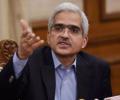
These are the highlights of RBI Governor Shaktikanta Das's statement and resolution of the Monetary Policy Committee (MPC):
 © 2026 Rediff.com - Advertise with us - Disclaimer - Privacy Policy - Sitemap - Feedback - About us - Terms of use - Grievances